
Diagnostic Tests
Diagnostic testing is essential to understanding and protecting your pet’s health. Early detection enables us to catch health concerns sooner, improve treatment outcomes, and build a baseline for future wellness care.
You know your pet best and can often tell when something feels "off," but pinpointing the exact cause requires deeper insight. We rely on advanced laboratory and diagnostic services to get a clear, complete picture of your pet’s internal health and well-being, ensuring that we make informed decisions and deliver the highest standard of care.
Blood and Urine Tests
Blood and urine tests are helpful to determine a normal baseline for your pet's health. Monitoring these results over time allows us to diagnose problems early, increasing the likelihood of timely intervention and recovery so your pet can live their best life. When a pet is ill or is preparing for general anesthesia, bloodwork is an important first step to evaluate their internal health.
We are equipped with state-of-the-art on-site laboratory machines to perform the following rapid laboratory tests:
Comprehensive Blood Panel:
Complete Blood Count (CBC): evaluating red blood cells determines how well oxygen is travels to the body’s tissues. White blood cells help the body fight infection and inflammation. Platelets help blood to clot, which is especially useful to know before a surgical procedure or with pets that experience sudden bruising and lethargy.
Blood Chemistry: measures enzymes to evaluating the following organ functions: kidneys, liver, pancreas. Electrolytes tell us about hydration, heart and kidney function, and some hormonal diseases. Blood glucose is crucial in diagnosing diabetes and other life threatening conditions such as insulinoma, sepsis, liver disease, some toxicities, and neonatal or toy breed illness.
Urinalysis:
This is an important test that is often paired with a comprehensive blood panel. This test evaluates kidney function, quantifies and determine the type(s) urine crystals, helps to diagnose diabetes, and looks for a urinary infections.
Additional on-site rapid blood tests include:
Thyroid (T4): to diagnose and monitor hyperthyroid cats and hypothyroid dogs.
SNAP canine pancreas-specific lipase (cPL): measures lipase coming solely from the pancreas rather than other organs like the liver or GI tract to help diagnose pancreatitis.
Blood and urine samples may also be shipped to off-site veterinary reference laboratories for specialized tests such as:
Urine Culture and Sensitivity: determines the type of bacterial infection and which antibiotics should be used to treat it.
TSH/free T4: used to diagnose thyroid disease with more precision.
Adrenal Testing (Low dose dexamethasone suppression test and/or ACTH Stimulation tests): help diagnose hormonal diseases such as Cushing’s Disease and Addison’s Disease.
TLI/Cobalamin/Folate tests: help diagnose and monitor chronic gastrointestinal diseases such as Exocrine Pancreatic Insufficiency (EPI), Vitamin B12 deficiency, and dysbiosis.
Bile Acids Assay: is a liver function test.
Cardiopet proBNP: evaluates heart muscle stretch and strain to help monitor feline and canine heart health.
Titer Tests & Serology: measure antibody levels to confirm immune response or assess protection against specific infectious diseases such as leptospirosis.
Diagnostic Imaging
Diagnostic imaging helps to diagnoses diseases, injuries, and health conditions in pets. Like in human medicine, veterinarians use various imaging techniques to get a detailed look at health issues going on inside your pet’s body without requiring invasive procedures. Dogs and cats are commonly sedated for X-rays and abdominal ultrasounds to prevent movement, to manage pain, and to reduce stress during precise positioning. Cardiac ultrasounds do not often require deep sedation, however, pets are given oral sedative medications at home before this test.
The most common types of diagnostic imaging used at Peninsula Veterinary Hospital include:
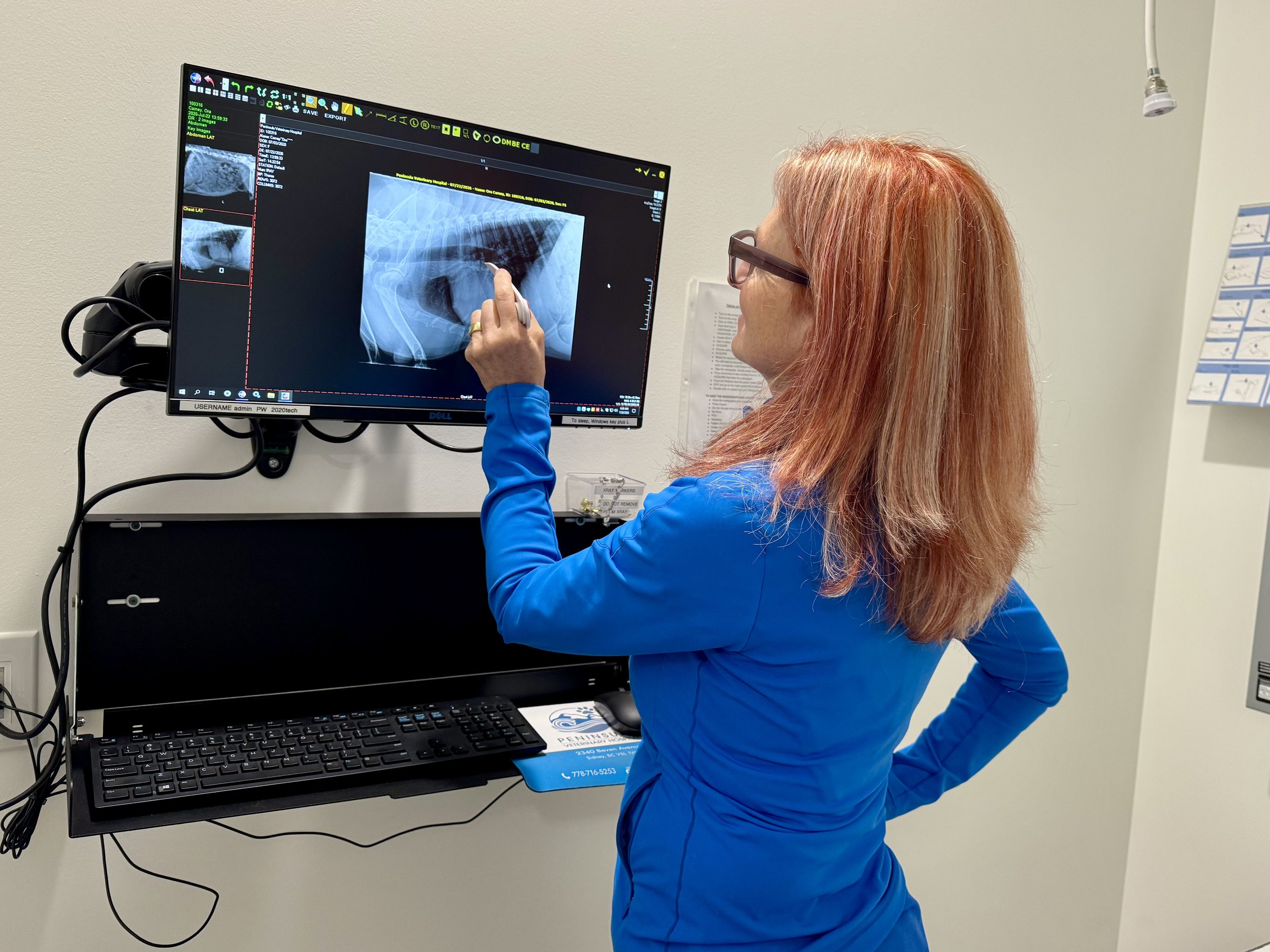
X-rays (Radiographs): use a safe level of electromagnetic waves to create pictures of your pet’s bones, as well as the size, shape, and position of organs like the heart, lungs, liver, and intestines. X-rays are especially helpful for diagnosing broken bones, arthritis, some types of tumors or masses, and problems such as fluid in the lungs or swallowed objects. At Peninsula Veterinary Hospital, we have an on-site full-body X-ray machine that produces digital images for immediate interpretating by our veterinarians. We also use teleradiology services to send X-ray images for review by board-certified radiologists.
Ultrasound: uses high-frequency sound waves to create real-time images and videos of your pet’s internal organs. It’s especially useful for examining soft tissues like the heart, liver, kidneys, and other abdominal organs. Ultrasound is commonly used to investigate internal illness, monitor organ health, and confirm pregnancy. At Peninsula Veterinary Hospital, we refer our patients to a mobile radiologist and a board certified veterinary cardiologist who come to our hospital to perform these advanced diagnostic tests and to interpret the findings.
Electrocardiogram (ECG)
An electrocardiogram (ECG or EKG) is a painless, non-invasive test that records the electrical activity of your pet’s heart. It is primarily used to detect abnormal heart rhythms (arrhythmias) and to monitor heart rate. ECGs may be recommended if an irregular heartbeat is heard on exam, if your pet is experiencing fainting episodes, or as part of pre-anesthetic screening in certain patients. The test is quick, well tolerated, and provides valuable information about heart rhythm. The ECG readings are collected digitally and sent to a board certified veterinary cardiologist for review and interpretation.
Continuous ECG monitoring is also performed for every patient during a general anesthesia.
Tonometry
Tonometry is a quick, non-invasive test used to measure the pressure inside your pet’s eyes. Abnormal eye pressures can be associated with conditions such as glaucoma or inflammation within the eye (uveitis). This simple procedure is typically well tolerated and can usually be performed during a routine exam without the need for sedation.
Endoscopy
Endoscopy is a minimally invasive procedure under general anesthesia that uses a small camera to examine the inside of your pet’s body. It allows evaluation of areas such as the esophagus, stomach, intestines, and, in some cases, the nose and airways. Endoscopy may be recommended to investigate ongoing symptoms like vomiting, weight loss, or chronic sneezing, and in certain situations, to retrieve foreign objects. Because it is minimally invasive, most pets experience less discomfort and a relatively quick recovery. At Peninsula Veterinary Hospital, we refer this procedure to an highly experienced mobile veterinarian who provides veterinary endoscopy services all over British Columbia.
Other Laboratory Tests
Additional on-site and send-out diagnostic tests that are commonly performed include fecal testing, skin and ear cytology, and tissue biopsies.
Fecal Testing: detects internal parasites like roundworms, hookworms, whipworms, and giardia, as well as bacterial imbalances. These tests are commonly sent to external reference veterinary laboratories.
Skin and Ear Cytology: evaluates samples from the skin, ears, and certain skin nodules using a microscope. This simple and quick test can identify bacterial or yeast infections as well as some types of cancer. Sometimes the veterinarian will recommend sending samples to an external reference laboratory for a follow up culture and sensitivity or for a board certified pathologist to review and interpret. Fluid samples from body cavities such as the chest, abdomen, or joints are often sent off to external reference laboratories for analysis.
Tissue Biopsies: are collected with a needle (fine needle aspirate or FNA) during your appointment or surgically under sedation or general anesthesia. These samples are analyzed with our on-site advanced microscope that combines artificial intelligence and digital imaging or are sent to an external reference laboratory for analysis by a board certified veterinary pathologist. The goals of tissue biopsies are to determine whether a surgically removed growth, lesion, or internal tissue sample is benign (harmless) or malignant (cancerous) and to determine if a mass was completely removed or not.